What acreage really costs in Australia
If the sale includes no machinery, fencing, sheds or tanks, expect to spend up to $100,000 getting the property functional. Then 1,500 to 1,600 hours a year of your own labour keeping it that way. Listings price the land. Nobody prices the rest.
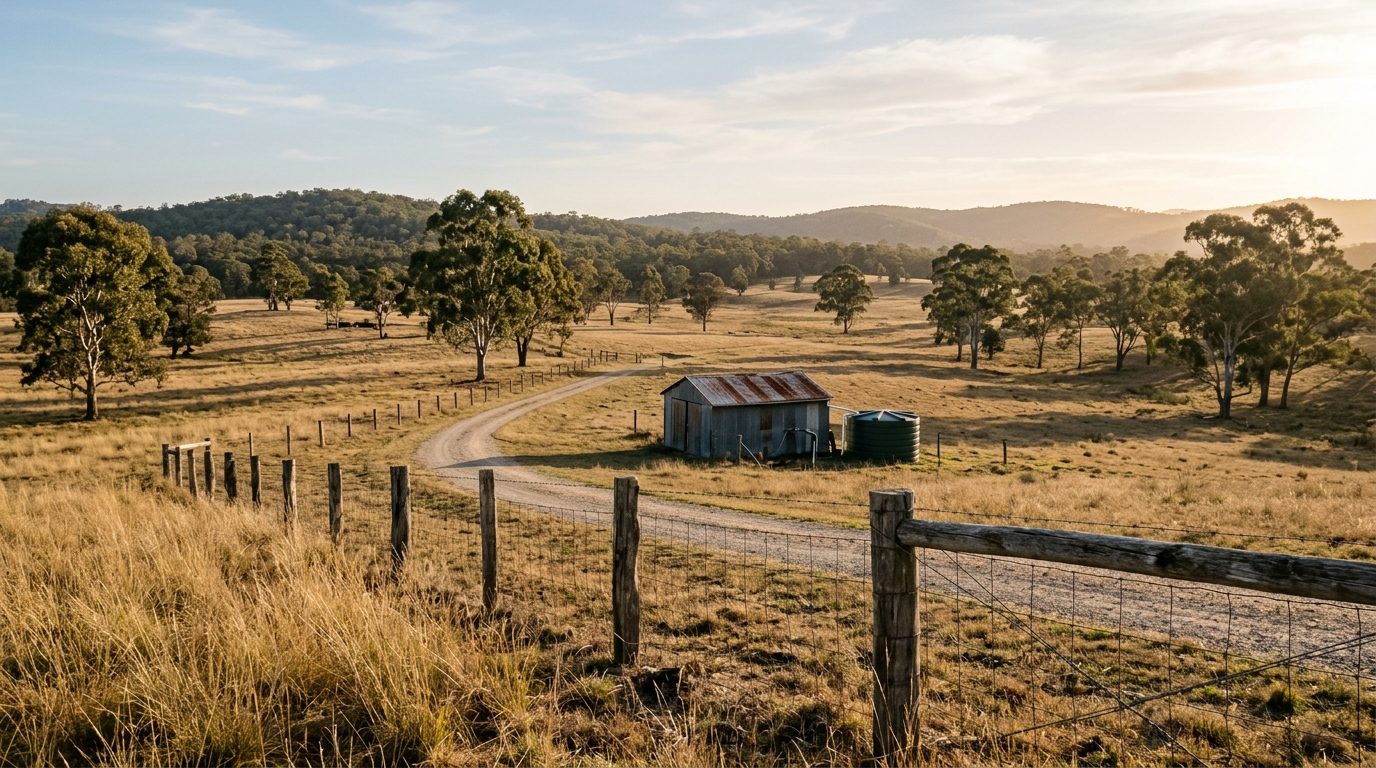
Real estate listings for acreage sell you the view. They don’t mention that the block arrives without a mower, without a boundary fence, without a water tank, and that you will spend more hours a year maintaining it than most people spend at a part-time job.
This guide costs both halves. The money, and the time.
The figures come from David, a horticulturist in regional NSW who has worked on private clients’ properties for decades and now lives on and maintains a three-acre property full time. His client work has run from two-acre blocks up to properties well over a hundred acres, mostly in districts where the nearest town of any size holds fewer than 10,000 people. Where a number below is his estimate rather than a bill he has paid, we say so.
Two properties of identical size can sit $80,000 apart on setup cost, because one sale included the shed, the fencing and the tank and the other included a house on bare dirt. Size, slope, aspect and inclusions drive everything below. Check the contract of sale for what conveys before you budget anything.
The setup bill: what you buy in the first year
If the sale includes no machinery, no fencing, no sheds and no tanks, David puts the cost of getting to a functional property at up to $100,000 on top of the purchase price. That sounds high until you list it out.
Fencing
Rural boundaries run longer than suburban ones and the construction is different: wooden posts with wire or wire netting, heavier gates, more substantial gate supports. What you build depends on what the land holds. Fencing rated for livestock costs more than fencing meant to keep a dog in, and some uses need an electric line on top.
Because the total is driven almost entirely by how much fence line you have, get quotes priced per linear metre before you do anything else. Our fencing cost guide covers per-metre rates by material.
Machinery
David treats the ride-on and the brushcutter as non-negotiable. You cannot maintain acreage without both, and a push mower usually joins them because the ride-on won’t fit everywhere.
Vehicles
A ute is the useful answer. A quad bike that can tow a trailer will do the job, but the ute does more of it.
- Ute — $20,000 to $60,000 depending on age and condition
- Quad bike — $2,000 to $12,000
Water, waste and structures
Even on mains water you want a second source: a 15,000 to 20,000 litre tank plumbed off the house gutters, or a small dam, or both. A workshop shed with a concrete floor, separate from any car garage, is the piece people underestimate most, because the mower, the fuel and the tools all have to live somewhere dry.
On waste, a grey water treatment plant captures wastewater from everything except the toilet and kitchen sink and lets you put it back into subsurface irrigation. Our septic system cost guide goes further into installed pricing.
If you have garden beds, an orchard or a vegetable patch, you need automated watering. Not for convenience. For the fortnight you go away in January and come back to find out what the property does without you.
The bill nobody quotes you: your own hours
This is the part that appears in no listing, and David was blunt about it.
A first-time acreage owner should expect to contribute 1,500 to 1,600 hours a year of their own labour across every property task. On a newly purchased three-acre property bought by owners with no experience, the weekly load starts around 30 hours.
Mowing alone, on 2¾ acres of lightly treed grass, takes about five hours a week through the eight-month growing season. That’s the ride-on plus the brushcutter along fence lines, around trees and around garden beds. Call it 160 hours a year on grass. The cutting heights he works to: 100mm through summer and autumn, 75mm through winter and spring.
You can reduce the load, and the levers are all the same one. Fewer garden beds. No orchard. No vegetable garden. Fewer trees. A property maintained to mowing only. Each decision buys back hours, and most people make them after the first summer rather than before it.
If you can’t supply the hours, you buy them. A contractor doing the mowing and brushcutting alone on 2¾ acres would charge a minimum of $9,100 a year. That figure is David’s estimate of what the work would be quoted at, drawn from the two years he spent quoting acreage mowing commercially, rather than an invoice he has paid. He stopped quoting for clients around fifteen years ago, so read it as an experienced estimate rather than a current market rate.
That estimate has a method behind it. Quoting acreage mowing, he times the machine rather than guessing: a 42 inch deck, 27 seconds to mow 50m, 105 seconds to mow 200m, and 10 seconds added for every turn at the end of a pass. Brushcutting the fence line is timed separately at 15 minutes per 50m run and 40 minutes per 200m run, both sides. On a 2.5 acre block with a fenced boundary and no trees, costed to 2026 prices that comes out at $400 for a single cut, of which the brushcutting is a larger share than the mowing. We’ve published that quote in full, line by line, in inside a tradie’s quote.
What a year of upkeep actually costs
The figures below describe a three-acre property with about ¾ of an acre in garden beds and the remaining 2¼ acres in lightly treed grass, with the owner doing the work.
Three costs sit outside that yearly rhythm. Equipment servicing runs about $100 across all machines for a basic service every 50 hours, and about $800 across all machines for the fuller service every 100 hours, covering the ride-on, push mower, brushcutter, quad bike, chainsaw and water pump. Septic pump-out for a 5,000 litre tank serving three adults comes around once every three years at about $350. The aeration pump on a grey water treatment plant needs replacing every two years at $250 to $350.
Where owners lack the time or the skills and pay contractors for the bulk of the work, David puts a realistic annual figure at as high as $20,000. That money has to come from somewhere separate. It sits on top of maintaining the house itself, and on top of whatever the household actually lives on.
Water splits acreage properties in two
Whether a property has mains water is the single biggest variable in its running cost.
On mains water, three adults will spend around $600 a year, plus filter servicing.
On tank water only, supplying everything, the arithmetic changes. A family of four including garden use needs 50,000 to 100,000 litres of storage.
One maintenance job belongs to the owner rather than a tradie: cleaning the inlet and outlet filters on a modern poly tank. Every six months at the outside, and every three months if the tank collects off roof gutters, which it will.
Tank pricing by size, what the plumber and pump add, how to size storage to your roof area, and the council rebates worth claiming are all covered in our rainwater tank cost guide.
Getting a tradie to come out
Distance changes the economics of every trade visit, and it shows up three ways.
Call-out and travel fees. Expect $100 to $160 added on top of the job itself, scaled to how far the tradie has to drive. In David’s experience there is rarely a minimum job size that gets you refused outright. The work eventually gets done. You just pay for the driving.
Waiting times. For a property not near a town of at least 15,000 to 20,000 people, plan on 14 to 21 days minimum just to get someone out to quote, then potentially weeks more before work starts. Genuine emergencies involving power, gas or water should be inside 24 hours.
Deterrent pricing. This one is worth understanding before you start ringing around. The further you widen your search, the more likely you are to either never hear back at all, or to receive a quote priced so the tradie doesn’t win the job. A number that high is an answer. It means no.
Read it that way and you save yourself a fortnight of chasing. It also changes how you compare quotes, because one outlier in a set of three is often a decline rather than a price. Our quote comparison tool will show you the spread, and the guide to hiring a contractor covers what to ask for in writing.
What bushfire preparation costs and involves
Clearance. No large trees within 50 metres of the main residence, and no trees within six metres of the nearest main power lines, though the power company usually handles that work. Where removal is needed, our tree removal cost guide covers pricing and the council permit that comes first.
Suppression. A sprinkler system fitted to the outside of the house runs $1,000 to $5,000 for materials, fittings, and a plumber to install it and test coverage across the structure. If that can’t be justified, the alternative is a mobile system: a 5–7hp motorised fire pump, 30 metres of hose and a firefighting nozzle, starting around $2,100 for quality gear.
The work you do yourself. Pick up dead leaf litter and fallen branches and burn them during the wet season so nothing accumulates at ground level. Walk the property weekly for fallen branches. That protects the house, and it protects the mower too: a stick jammed in the drive belts of a ride-on turns into hundreds of dollars of repair you could have avoided. Through the hot dry months, never let grass exceed 100mm.
Two things that cost nothing. Know your nearest neighbours, swap phone numbers, and have an evacuation plan that covers the town rather than just your street address.
Check what feeds the town water supply to your meter, and what happens to it in a major bushfire. Many small towns will cut supply to properties and direct it to the fire service alone. If mains is your only water, the day you find that out is the worst possible day to find it out.
What people buy and never use
New owners over-buy, and the pattern is consistent. David’s list of the equipment most often purchased and least often used:
- Rotary hoes
- Log splitters
- Small utility tractors and their attachments
- Motorised post hole diggers
- Small woodchippers
- Quad bikes, if you already own a ute
Every one of those is cheaper to hire on the two or three days a year you need it. Hire first, and buy only after you have hired the same machine three years running.
The genuinely essential list is short: ride-on mower, push mower, brushcutter, chainsaw, battery sprayer and water pump, plus hand tools, a wheelbarrow and a trailer.
What to check before you sign
David’s list for anyone about to make an offer on acreage.
The land itself
- Aspect — north, south, east, west, and whether it suits what you intend to do with the land
- Climate — average annual rainfall, prevailing wind strength and direction, and the number of frost days a year
- Slope — too flat or too steep for your purpose
- Soil — heavy clay or sandy loam, how deep the topsoil runs, and whether the soil is effectively dead and will need organic matter trucked in
- Drainage — natural springs, boggy ground, permanent wet areas. Subsurface drainage gets expensive on acreage because of the distance pipe has to run to get water off the property
- Neighbouring runoff — water arriving on your land from someone else’s
- Tree cover — too many, or none at all, and whether you have the skills and gear for fallen timber
Services and boundaries
- Whether the boundary is fully fenced, both against neighbours and against any public road
- Mains water, tank water, or no water at all
- Whether the property is connected to the electricity grid, or merely near it
Legal and council
- Covenants on the title that restrict what you can do with the land
- Rates and levies
- Council expectations on clearing, fire hazard reduction, and permits for removing live or dead timber
- Local restrictions on burning organic waste
Living there
- Schools, if you need them
- Public transport, if you need it
- Medical facilities, and the distance to the nearest hospital
Four questions that decide whether it works
Lifestyle fit. Children who depend on you for transport, or a social calendar that fills your weekends, eat the same hours the property needs. Time is the scarce resource here, not money.
Age and health. Whether you have the physical capacity for the work, now and in ten years, or will be paying someone else to do it.
Setup capital. Where the sale includes no machinery, tools, sheds, tanks or fencing, budget up to $100,000 on top of the purchase price.
Ongoing funds. Where the maintenance money comes from, and whether it is genuinely separate from your house budget and your living costs. Retired buyers need a retirement income that can carry it.
David’s own summary is hard to improve on: if outgoings consistently exceed incomings, you are in trouble. Acreage costs get added to your existing life, not substituted for it.
Frequently asked questions
How much does it cost to set up a few acres in Australia?
If the sale includes no machinery, fencing, sheds or tanks, budget up to $100,000 on top of the purchase price. The big items are boundary fencing at $5,000 to $20,000, a ride-on mower at $6,500 to $13,000, a ute at $20,000 to $60,000, a shed and concrete pad at roughly $3,000 to $8,000 combined, and water tank infrastructure from $3,500. What the contract of sale includes changes the total more than anything else.
How many hours a week does acreage take to maintain?
A first-time owner on three acres should expect around 30 hours a week to start, working out to 1,500 to 1,600 hours a year across all property tasks. Mowing and brushcutting alone accounts for about five hours a week through the eight-month growing season, or roughly 160 hours a year. The load drops as you simplify the property: fewer garden beds, no orchard, and maintenance reduced to mowing only.
What does a year of acreage maintenance cost?
With the owner doing the work on a three-acre property, roughly $5,000 to $7,000 a year covering fuel, servicing, fertiliser, mulch, filters, driveway gravel and fence repairs. Paying contractors for most of the work instead can push that as high as $20,000 a year. Contractor mowing on 2¾ acres alone would be quoted at a minimum of $9,100 a year.
Will tradies come out to a rural property?
Generally yes, but expect a call-out and travel fee of $100 to $160 on top of the job. The bigger cost is time: for properties not near a town of 15,000 to 20,000 people, allow 14 to 21 days just to get someone out to quote, and potentially weeks more before work starts. Emergencies involving power, gas or water should be attended within 24 hours.
Why did one tradie quote me so much more than the others?
Often because they don’t want the job. The further you search from your property, the more likely you are to get either silence or a quote priced high enough that they won’t win it. Treat a wild outlier as a polite decline rather than a price, and move on rather than negotiating.
What machinery do you actually need on a few acres?
A ride-on mower, a push mower, a brushcutter, a chainsaw, a battery sprayer and a water pump, plus hand tools, a wheelbarrow and a trailer. Rotary hoes, log splitters, small tractors, post hole diggers, woodchippers and quad bikes are the items new owners most often buy and least often use, and all are cheaper to hire for the few days a year they are needed.
What does tank water cost if the property has no mains connection?
A family of four including garden use needs 50,000 to 100,000 litres of storage. The tank runs $9,000 to $15,000, installation, plumbing, pump and base add at least $5,000, an electrician to connect the pump is up to $350, and carting water for the first fill costs $250 to $350 per 20,000 litres. Filters then run about $700 a year.
Sources & further reading
- Costs, time estimates and buying advice on this page were contributed by David, a horticulturist in regional NSW, based on maintaining a three-acre property full time and on decades of work across client properties ranging from two acres to well over a hundred.
- Ranges reflect his estimates of what the work and equipment cost, not a survey of advertised prices. The contractor mowing figure of $9,100 a year is his professional estimate of what that work would be quoted at, rather than a bill he has paid.
- Figures drawn from his own property describe one property, in one district, with one set of conditions and one set of inclusions. Slope, soil, tree cover, water connection and what conveyed with the sale will move every number on this page.
- Tree protection requirements, burning restrictions and land clearing rules are set by local councils and vary considerably. Confirm yours before commissioning any work.
Cost ranges here are planning estimates that vary by region and property — see how we research and what our numbers mean, and always confirm with local, itemised quotes.