Rainwater tank cost in Australia
A 5,000 litre poly tank is $1,300 to $2,450. Getting it to actually supply your house is a separate bill again: base, pump, plumbing and diverters push a complete system to $1,500 to $5,000. Almost every quote you compare will include a different subset of those.
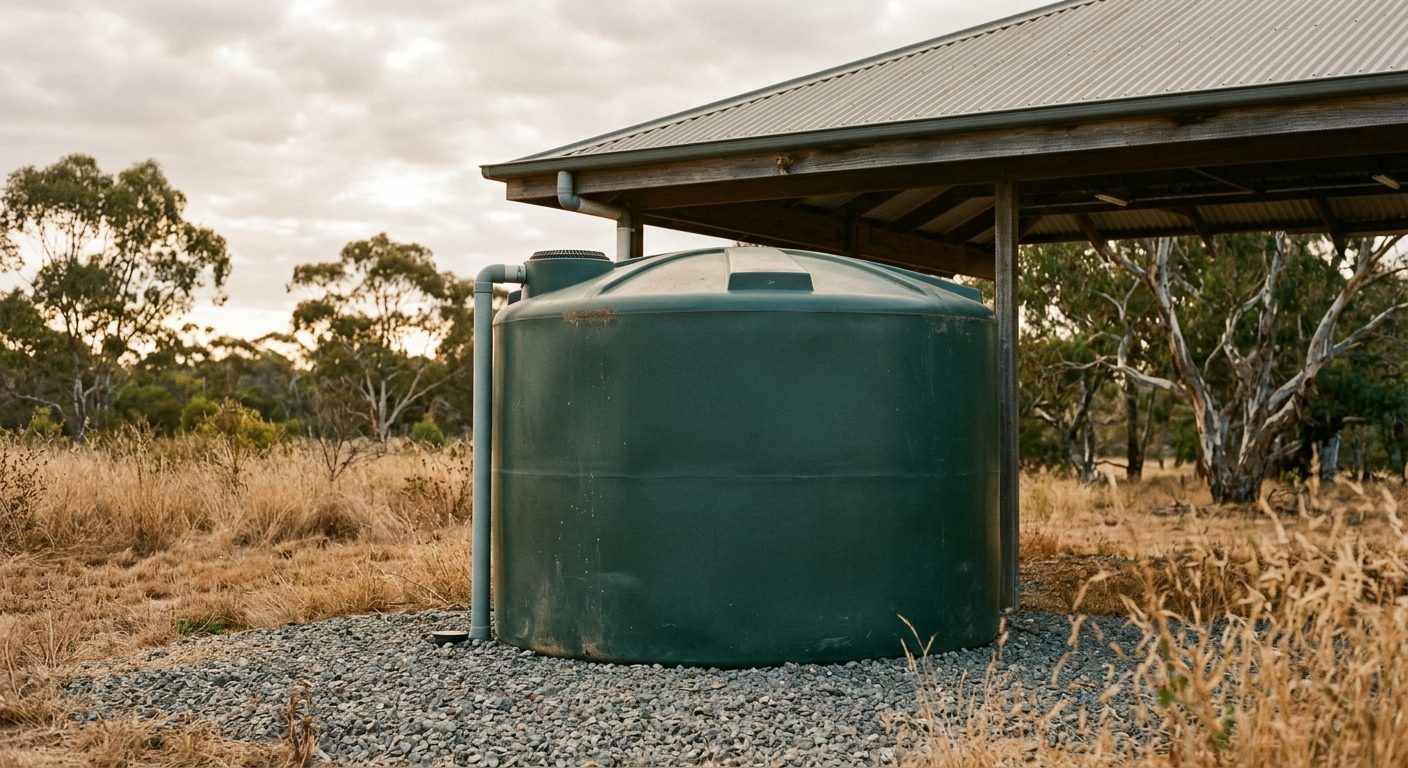
The advertised price of a rainwater tank is the price of an empty plastic vessel sitting on a truck. That is genuinely all it covers.
Everything that turns it into a water supply gets quoted separately, and the reason tank quotes are so hard to compare is that suppliers, plumbers and installers each draw the line in a different place. One quote includes the base and the pump. The next assumes you have both. This guide splits the two apart so you can see which one you are actually holding.
What the tank itself costs
Poly is the default for residential tanks in Australia. It is the cheapest per litre, it handles Australian UV conditions when it is made for them, and quality tanks carry warranties around the twenty-year mark. Steel and concrete cost more, and concrete in particular is a different conversation because it usually involves excavation.
A note on the cheap end of the market. Lighter wall construction and shorter warranties are how a tank gets to be the cheapest one on the page, and a tank that needs replacing at year twelve rather than year twenty-five has quietly doubled its own cost. Check the warranty term and whether the manufacturer is still likely to be around to honour it.
Check the stated capacity too. Some suppliers round volumes up, so a tank sold as a nominal size may hold meaningfully less than the number on the label.
Large tanks travel on their own truck and rural delivery zones attract a surcharge. Ask what the delivered price is, to your address, before you compare two suppliers on the sticker price.
Sizing the tank to your roof, not to your budget
Most people pick a tank by what fits beside the house. The better question is how much water your roof can actually deliver, because a tank bigger than your catchment is a tank that never fills.
The arithmetic is simple. One millimetre of rain on one square metre of roof yields one litre of water. Allow for what is lost to splash, evaporation and the first flush and you keep roughly 80 to 85 per cent of it.
Roof area in m² × annual rainfall in mm × 0.8 = litres a year.
A 200m² roof in a district getting 900mm a year yields around 144,000 litres across the year. That sounds enormous until you notice it does not arrive evenly. Sizing is really about bridging the dry stretch between falls, not about capturing the annual total, which is why properties in summer-dry climates need proportionally more storage than the rainfall figure suggests.
Two practical consequences. If you are on mains water and the tank is for the garden and a toilet, catchment is rarely the binding constraint and you can size to the space you have. If the tank is your only supply, work backwards from the longest dry period your district records, not from the annual average.
Installation and plumbing: the second bill
This is where quotes diverge, and where the total quietly doubles.
Three of those deserve explanation.
The base. A full 5,000 litre tank weighs five tonnes. It needs a properly prepared, level base of compacted crushed rock or concrete, and a tank that settles unevenly can split. This is not a corner worth cutting and it is the item most often left out of a supply-only quote.
First flush diverters. These catch the initial run of water off the roof, which carries the dust, leaf litter and bird droppings that accumulated since the last fall, and drain it away before the clean water reaches the tank. You need one on each downpipe feeding the tank. The general guideline is to divert at least 20 litres for every 100m² of roof area. They are recommended rather than mandatory for garden-only tanks, and they matter considerably more once the water is going anywhere near a toilet, a washing machine or a hot water service.
Licensed plumbing. Connecting a tank to any internal fixture is licensed plumbing work, and in NSW DIY connections to household plumbing are not permitted. Garden-only setups, where you run a hose off a tap and a pump, are the case most handy owners can do themselves. Rainwater system design and installation sits under AS/NZS 3500. Expect metropolitan pricing to run somewhat above regional rates for the same job.
When the tank is your only water supply
Everything above assumes a tank that supplements mains water. Properties with no town connection are a different order of cost, and this is where our contributor material comes in.
David, a horticulturist in regional NSW who maintains a three-acre property full time, puts the storage requirement for a family of four including garden use at 50,000 to 100,000 litres. At that scale the tank runs $9,000 to $15,000, installation, plumbing, pump and base add at least $5,000, and an electrician to connect power to the pump is up to $350 on top.
Then there is the fill. A new tank does not wait for rain, so carted water for the first fill costs $250 to $350 per 20,000 litres, and in a dry year you may be buying water again.
On a modern poly tank with a fine grade inlet filter and a fine grade outlet filter before the pump, David cleans those filters at six month intervals at the outside, and every three months where the tank collects off roof gutters. Filter servicing across the tank and house pump he budgets at around $700 a year minimum. Neglected filters are the most common cause of a pump working harder than it should.
Our guide to what acreage really costs sets water alongside the rest of the picture, including fencing, machinery, septic and the labour hours a rural property demands.
Rebates worth chasing before you buy
Rainwater tank rebates in Australia are administered by councils and water authorities rather than nationally, so what you can claim depends entirely on your address. The amounts are large enough to be worth a phone call.
Rebates commonly scale with tank capacity and with whether the tank is plumbed to internal fixtures rather than just the garden. Programs in various NSW council areas have offered tiers from a couple of hundred dollars up to $2,000 or more, often with additional amounts for connecting a toilet or a washing machine. Some Queensland regional councils have run schemes up to around $2,000 for larger capacities, aimed at water security. South Australia has offered rebates covering tank purchase and plumbing into eligible fixtures. Western Australia has run a regional rainwater tank rebate for eligible towns, conditional on the tank being plumbed to a toilet or washing machine.
Four conditions catch people out, and they recur across almost every program:
- Minimum capacity. Usually somewhere between 1,000 and 5,000 litres depending on the scheme.
- Internal connection. The larger amounts generally require the tank to be plumbed to a toilet, a cold laundry outlet or a hot water service, not just a garden tap.
- Approval before purchase. Several schemes will not accept retrospective applications, so buying first can disqualify you outright.
- A tank required by BASIX or a development consent usually does not qualify. Rebates are generally for tanks you were not already obliged to install.
Programs open, close and exhaust their funding through the year, and many are first come, first served. Confirm the current terms with your own council or water authority rather than relying on any summary, including this one.
What a tank costs to run
Tanks are close to passive, but they are not free to own.
Sludge accumulates at the bottom of a tank over time and is generally cleaned out every few years rather than annually. A first flush diverter and a good inlet filter slow that accumulation down considerably, which is part of why the diverter pays for itself.
Where a tank is plumbed into the house, the pump is the component that eventually fails. Budget for a replacement rather than being surprised by one.
If a tank is going in as part of a broader upgrade, our septic system cost guide and hot water system guide cover the two systems it most often gets bundled with. And because tank quotes vary so widely in what they include, put three side by side using our quote comparison tool before you decide.
Frequently asked questions
How much does a rainwater tank cost in Australia?
The tank alone runs roughly $700 to $1,400 for a small garden or slimline tank, $1,300 to $2,450 for 5,000 litres, $2,000 to $3,500 for 10,000 to 15,000 litres, and $9,000 to $15,000 for the 50,000 to 100,000 litre storage a rural property needs for whole-of-house supply. Installation and plumbing are separate and typically bring a complete tank-to-house system to $1,500 to $5,000 or more.
What size rainwater tank do I need?
Work from your roof rather than the space beside the house. One millimetre of rain on one square metre of roof yields one litre, and you keep about 80 per cent after losses, so roof area in square metres multiplied by annual rainfall in millimetres multiplied by 0.8 gives litres a year. Size for the longest dry stretch between falls rather than the annual total. A family of four relying entirely on tank water, including garden use, needs 50,000 to 100,000 litres.
Do I need a plumber to install a rainwater tank?
For any connection to internal fixtures, yes. Connecting a tank to toilets, laundry outlets or a hot water service is licensed plumbing work, and DIY connections to household plumbing are not permitted in NSW. A garden-only setup where you run a tap and a pump is the case most handy owners can do themselves. Rainwater system installation is covered by AS/NZS 3500.
What is a first flush diverter and do I need one?
It catches the first run of water off the roof, which carries accumulated dust, leaf litter and bird droppings, and drains it away before clean water reaches the tank. You need one on each downpipe feeding the tank, and the guideline is to divert at least 20 litres per 100 square metres of roof. They cost $150 to $400 each, are recommended rather than mandatory for garden-only tanks, and matter much more once the water goes anywhere near a toilet or washing machine.
Can I get a rebate for a rainwater tank?
Often, but it depends on your council or water authority rather than on any national scheme. Amounts commonly scale with tank size and with whether the tank is plumbed to internal fixtures, and have reached $2,000 or more in some areas. Watch for three conditions: a minimum capacity, a requirement to apply before you buy, and the exclusion of tanks you were already required to install under BASIX or a development consent.
What does a rainwater tank cost to maintain?
Budget around $700 a year for filter replacement and servicing across the tank and house pump. Desludging runs $200 to $600 every few years rather than annually. Pumps last roughly 8 to 15 years and cost $200 to $900 to replace. Cleaning the inlet and outlet filters is an owner job, done every three to six months depending on whether the tank collects off roof gutters.
Sources & further reading
- Storage requirements for whole-of-house rural supply, filter servicing intervals and costs, and carted water pricing were contributed by David, a horticulturist in regional NSW, based on maintaining a three-acre property full time. His figures are estimates from his own property rather than a market survey.
- Tank supply pricing cross-checked against 2026 published Australian pricing from tank manufacturers and factory-direct suppliers including The Tank Factory, Polymaster and Tankworld.
- Plumbing, pump, diverter and connection pricing cross-checked against 2026 Australian trade cost data, including state-level guides for NSW and Victoria.
- Rainwater system design and installation is covered by AS/NZS 3500. Connection to internal fixtures is licensed plumbing work; licence registers are maintained by state fair trading bodies.
- Rebate programs are administered by individual councils and water authorities, change through the year and are frequently first come, first served. Confirm current terms directly with your council before purchasing.
Cost ranges here are planning estimates that vary by region and property — see how we research and what our numbers mean, and always confirm with local, itemised quotes.